Introduction
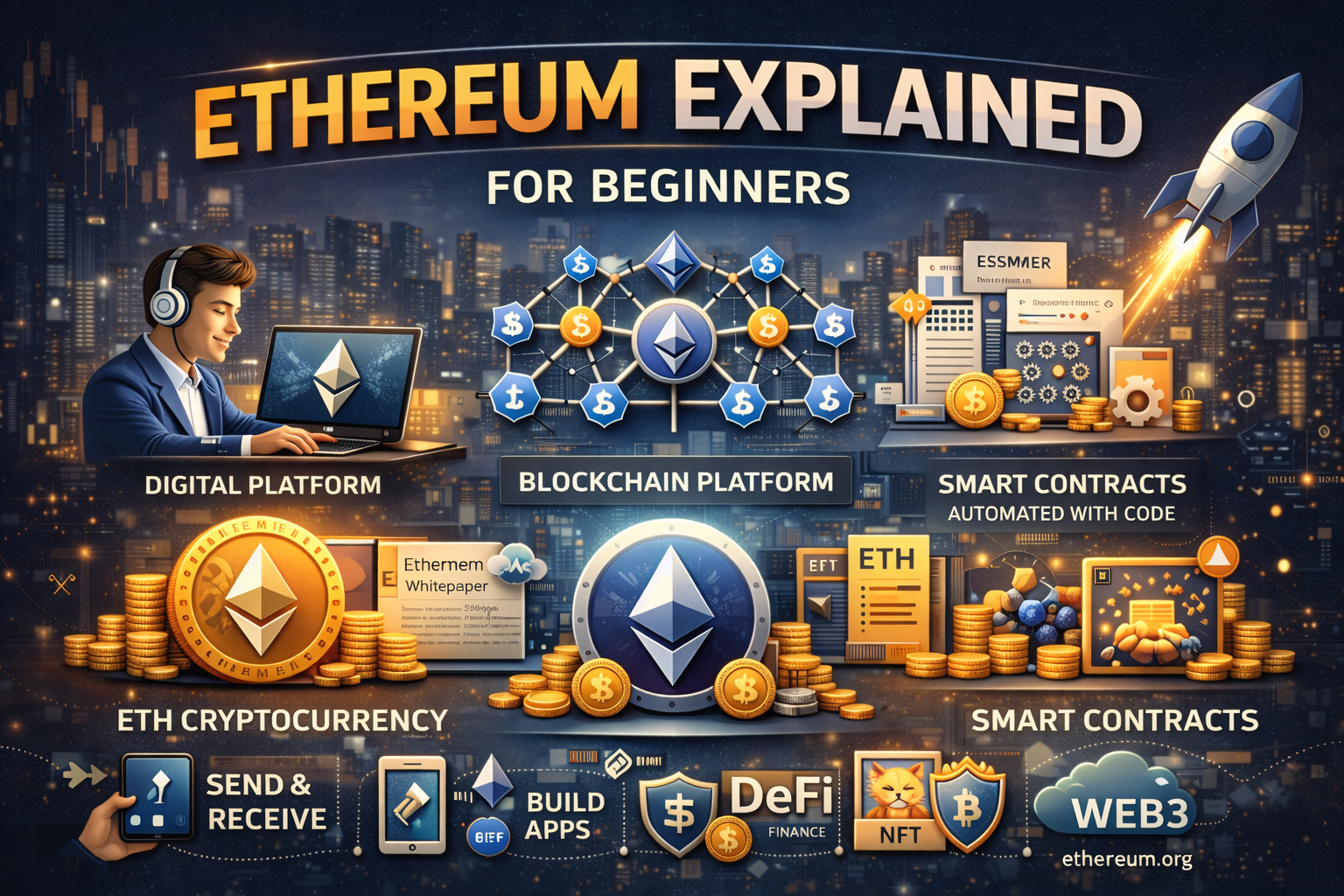
Ethereum Explained simply: Ethereum is a leading blockchain platform that allows people to send digital money (ETH) and build decentralized applications without banks or intermediaries.
Since its launch in 2015, Ethereum has become one of the most important technologies in crypto because it introduced smart contracts and programmable blockchain systems.
In this guide, you will learn what Ethereum is, how it works step by step, its key features, benefits, risks, and future potential.
What Is Ethereum?
Ethereum is a decentralized blockchain network designed to support more than just payments. While Bitcoin focuses mainly on digital currency, Ethereum allows developers to create applications directly on the blockchain.
Ethereum powers:
- Smart contracts
- Decentralized finance (DeFi)
- NFTs (digital collectibles)
- Web3 applications
The native cryptocurrency of Ethereum is called Ether (ETH).
Who Created Ethereum?
Ethereum was proposed by Vitalik Buterin in 2013 and officially launched in 2015.
The goal was to create a blockchain system that could run programmable agreements and applications, not just transfer money.
Why Ethereum Matters Today
Ethereum is important because it expanded blockchain technology.
It enables:
- Trustless digital agreements
- Decentralized applications
- Financial services without banks
- Digital ownership through NFTs
Moreover, many modern crypto innovations are built on Ethereum’s ecosystem.
How Does Ethereum Work? (Step-by-Step)
Ethereum works through blockchain technology, validators, and smart contract execution.
Step 1: A Transaction or Contract Is Created
First, a user performs an action such as:
- Sending ETH
- Using a DeFi platform
- Buying an NFT
- Executing a smart contract
Step 2: The Network Broadcasts the Request
Next, the transaction spreads across Ethereum’s global network of nodes.
This distribution keeps Ethereum decentralized and secure.
Step 3: Validators Confirm the Transaction
Ethereum uses Proof of Stake (PoS).
Validators review transactions and confirm them based on staked ETH.
As a result, the network stays secure without heavy mining energy.
Step 4: A Block Is Added to the Blockchain
After validation, Ethereum adds the transaction to a new block.
The blockchain permanently stores this data, making it very difficult to alter.
Step 5: The Transaction Becomes Final
Finally, the transaction completes successfully.
Therefore, Ethereum provides secure transfers and automated contract execution.
What Are Smart Contracts?
Smart contracts are Ethereum’s biggest innovation.
A smart contract is a piece of code that runs automatically when conditions are met.
For example:
- A loan repays automatically
- An NFT transfers ownership instantly
- A payment releases after delivery
Because of this automation, smart contracts remove the need for intermediaries.
What Is Ether (ETH)?
Ether (ETH) is Ethereum’s native cryptocurrency.
ETH is used for:
- Paying transaction fees (gas fees)
- Staking to secure the network
- Buying NFTs and using DeFi apps
- Transferring value like digital money
What Are Gas Fees?
Gas fees are small payments users make to process Ethereum transactions.
Gas fees depend on:
- Network activity
- Transaction complexity
Therefore, fees may increase during busy periods.
Ethereum vs Bitcoin
| Feature | Bitcoin | Ethereum |
|---|---|---|
| Purpose | Digital currency | Blockchain platform |
| Smart Contracts | No | Yes |
| Consensus | Proof of Work | Proof of Stake |
| Supply | Fixed limit | No fixed cap |
| Main Use | Store of value | DeFi, NFTs, Web3 |
So, Ethereum focuses more on applications, while Bitcoin focuses on money.
Uses of Ethereum
Ethereum has many real-world use cases:
1. Decentralized Finance (DeFi)
Ethereum powers DeFi apps for:
- Lending
- Borrowing
- Token swaps
2. NFTs and Digital Ownership
NFT marketplaces depend heavily on Ethereum smart contracts.
3. Web3 Applications
Ethereum supports decentralized apps that give users more control over data.
4. DAOs (Decentralized Communities)
Ethereum allows decentralized governance models through DAOs.
Benefits of Ethereum
Ethereum offers several advantages:
✅ Programmable blockchain
✅ Large developer ecosystem
✅ Supports DeFi and NFTs
✅ Secure and decentralized
✅ Future-focused technology
Moreover, Ethereum continues to evolve through upgrades.
Risks of Ethereum
Ethereum also involves risks:
- Gas fees can be high
- Crypto markets remain volatile
- Smart contract bugs may occur
- Regulatory uncertainty exists
Therefore, beginners should learn and invest responsibly.
Is Ethereum Safe for Beginners?
Ethereum is a trusted blockchain network, but beginners should:
- Use secure wallets
- Avoid scams
- Never share private keys
- Start with small investments
With proper safety, Ethereum can be explored confidently.
Future of Ethereum
Ethereum’s future looks strong due to:
- Web3 growth
- DeFi adoption
- Scaling improvements
- Institutional interest
Although challenges remain, Ethereum is expected to stay a major blockchain platform.
Frequently Asked Questions (FAQ)
Is Ethereum better than Bitcoin?
Ethereum and Bitcoin serve different purposes. Ethereum focuses on applications, while Bitcoin focuses on digital money.
Can Ethereum be mined?
Ethereum now uses Proof of Stake, so traditional mining is no longer used.
What is Ethereum mainly used for?
Ethereum is used for smart contracts, NFTs, DeFi, and Web3 applications.
Conclusion
Ethereum is one of the most powerful blockchain platforms in the world. This Ethereum Explained guide shows that Ethereum is more than a cryptocurrency — it is a foundation for smart contracts, decentralized finance, NFTs, and the future internet.
For beginners, learning Ethereum is an important step toward understanding modern blockchain technology.
Internal Links
Read: What is Blockchain?
https://cryptorbite.com/what-is-blockchain
Learn: Bitcoin Explained
https://cryptorbite.com/bitcoin-explained
Guide: Smart Contracts Explained
https://cryptorbite.com/smart-contracts-explained
🔒 Disclaimer
This article is for educational purposes only and does not provide financial or investment advice. Cryptocurrency investments carry risk.