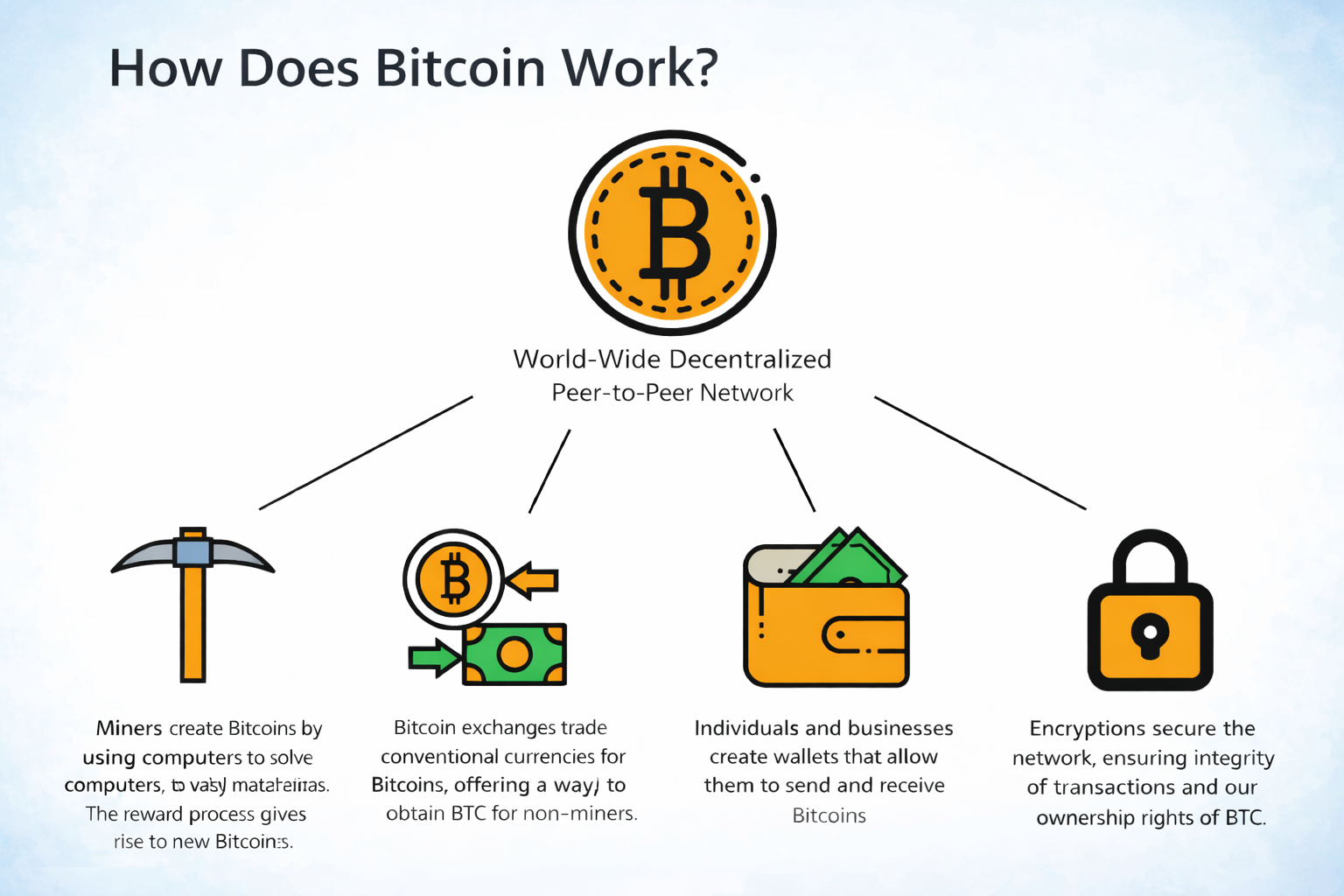
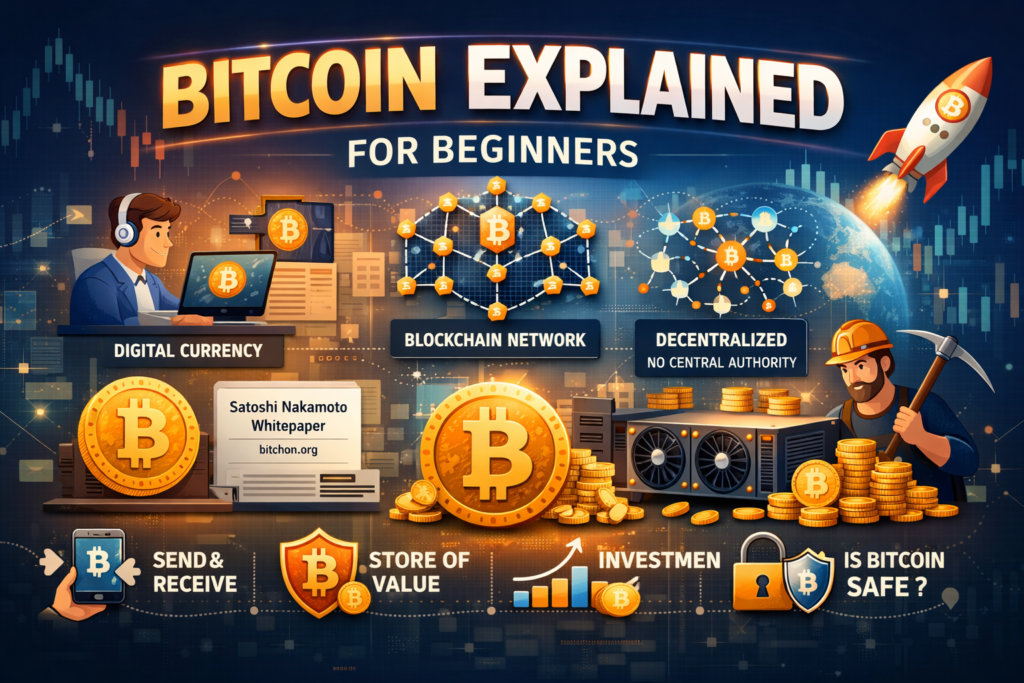
Bitcoin explained in simple words: Bitcoin is the world’s first cryptocurrency that allows people to send and receive money digitally without banks or central authorities.
Since its launch in 2009, Bitcoin has become one of the most discussed financial innovations. Today, many people call it “digital gold” because of its limited supply and global adoption.
In this beginner-friendly guide, you will learn what Bitcoin is, how it works step by step, why it is valuable, and what beginners should know before using it.
What Is Bitcoin?
Bitcoin is a decentralized digital currency that works on a peer-to-peer network. Unlike traditional money, no government or bank controls Bitcoin.
Instead, Bitcoin runs on blockchain technology, which records transactions securely and transparently.
In simple terms:
Bitcoin allows you to transfer value online without intermediaries.
Who Created Bitcoin?
Bitcoin was introduced in 2009 by an unknown person or group using the name Satoshi Nakamoto.
The idea behind Bitcoin was to create a financial system that works independently of traditional banks.
Even today, Satoshi’s real identity remains a mystery.
Why Is Bitcoin Important?
Bitcoin is important because it introduced a new way of handling money.
It offers:
- Decentralization
- Borderless payments
- Transparency
- Limited supply
Moreover, Bitcoin has inspired thousands of other cryptocurrencies and blockchain projects.
Bitcoin Explained: How Does Bitcoin Work?
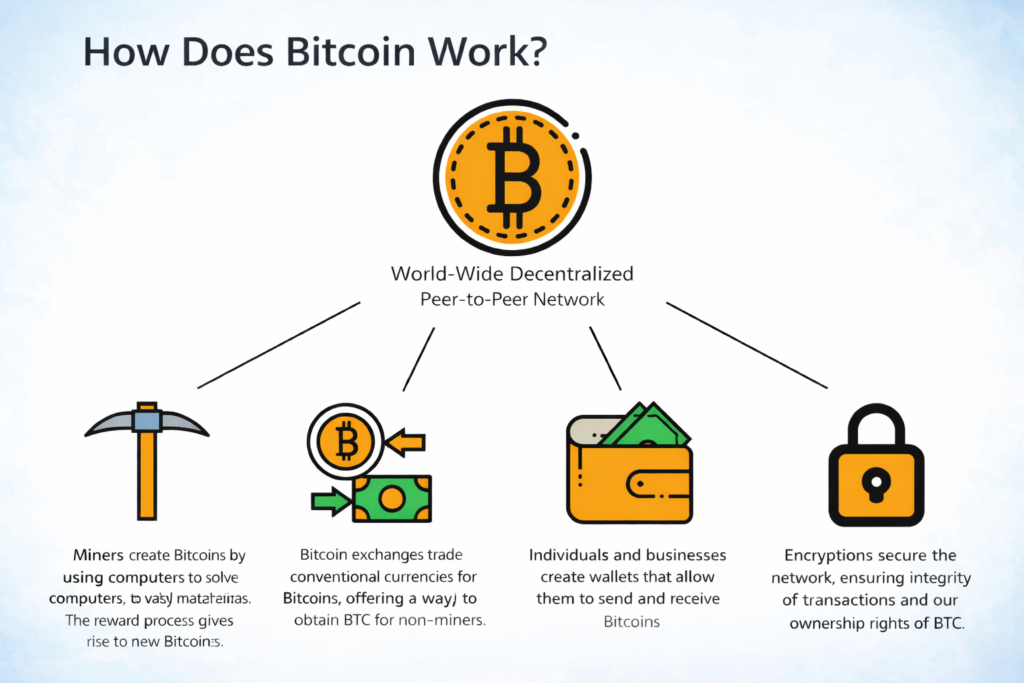
Bitcoin works through a combination of blockchain, cryptography, and network validation.
Let’s break it down clearly.
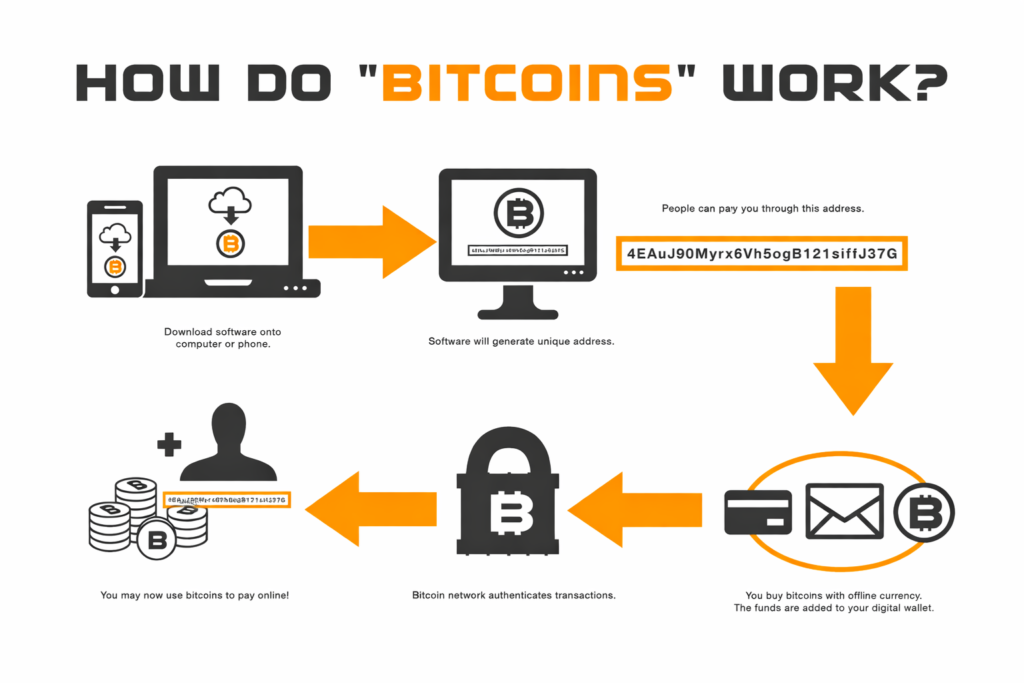
Step 1: A Transaction Is Created
When someone sends Bitcoin, a transaction includes:
- Sender wallet address
- Receiver wallet address
- Amount transferred
Step 2: The Transaction Is Shared With the Network
Next, the transaction spreads across a global network of computers called nodes.
These nodes help maintain decentralization.
Step 3: The Network Verifies the Transaction
Bitcoin uses a process called Proof of Work.
Miners verify transactions by solving complex mathematical puzzles.
As a result, the network prevents fraud and double spending.
Step 4: A New Block Is Added to the Blockchain
Once verified, transactions group together in a block.
The blockchain permanently stores this block, making the record nearly impossible to change.
Step 5: The Transaction Becomes Final
Finally, the Bitcoin transfer completes, and the receiver gets the funds securely.
Therefore, Bitcoin transactions remain transparent and permanent.
What Is Bitcoin Blockchain?
The Bitcoin blockchain is a public digital ledger that records every Bitcoin transaction.
Key features include:
- Security through cryptography
- Transparency for public verification
- Decentralized control
This structure makes Bitcoin highly resistant to manipulation.
What Is Bitcoin Mining?
Bitcoin mining is the process that:
- Confirms transactions
- Secures the network
- Introduces new Bitcoins into circulation
Miners earn rewards for adding verified blocks to the blockchain.
However, mining requires powerful computers and significant energy.
Why Is Bitcoin Valuable?
Bitcoin’s value comes from several factors.
Limited Supply
Bitcoin has a maximum supply of 21 million coins.
Because of this scarcity, many investors compare it to gold.
Global Demand
Bitcoin is traded worldwide and has increasing adoption.
Decentralization
No central authority controls Bitcoin, which makes it unique.
What Can Bitcoin Be Used For?
Bitcoin has multiple real-world uses.
1. Digital Payments
People use Bitcoin for fast global transactions.
2. Store of Value
Many hold Bitcoin as a long-term asset.
3. Investment
Bitcoin is widely traded and considered a major crypto asset.
4. Financial Freedom
Bitcoin enables peer-to-peer payments without banking restrictions.
Benefits of Bitcoin
Bitcoin offers several advantages:
✅ Decentralized system
✅ Secure transactions
✅ Limited inflation risk
✅ Borderless transfers
✅ Transparent blockchain ledger
Moreover, Bitcoin continues to gain recognition globally.
Risks of Bitcoin (Important for Beginners)
Bitcoin is not risk-free.
Price Volatility
Bitcoin prices can rise or fall quickly.
Regulatory Uncertainty
Different countries apply different rules.
Scams and Fraud
Hackers often target inexperienced users.
Therefore, beginners should focus on education and security first.
Is Bitcoin Safe?
Bitcoin itself is highly secure due to blockchain technology.
However, safety depends on how users protect:
- Private keys
- Wallet security
- Exchange accounts
Using strong passwords and 2FA is essential.
Bitcoin vs Traditional Money
| Feature | Bitcoin | Traditional Currency |
|---|---|---|
| Control | Decentralized | Government-controlled |
| Supply | Limited | Unlimited printing possible |
| Transparency | High | Low |
| Borderless | Yes | Limited |
| Inflation Risk | Lower | Higher |
Future of Bitcoin
Bitcoin adoption continues to grow with:
- Institutional interest
- Payment integrations
- Global awareness
Although volatility remains, Bitcoin is likely to remain a major part of digital finance.
Frequently Asked Questions (FAQ)
Is Bitcoin legal?
Bitcoin legality depends on the country. Most nations regulate it, while some restrict it.
Can Bitcoin be hacked?
The Bitcoin blockchain is secure, but individual wallets can be hacked if users ignore security.
Is Bitcoin good for beginners?
Yes, beginners can start with small amounts and focus on learning first.
Conclusion
Bitcoin is the foundation of the cryptocurrency revolution.
This Bitcoin explained guide shows that Bitcoin is more than just digital money — it is a decentralized financial system with global impact.
For beginners, understanding Bitcoin is the first step toward exploring crypto safely and responsibly.
🔒 Disclaimer
This article is for educational purposes only and does not constitute financial or investment advice. Cryptocurrency investments carry risk.