Tether spent early 2026 expanding into gold. By the end of March, it had already cut the senior hires behind that push, turning what looked like an ambition story into a test of how the company wants to look before auditors examine its books.
Paolo Ardoino said that Tether wanted to allocate 10% to 15% of its $20 billion proprietary investment portfolio to physical gold. Two days later, Tether reported more than $10 billion in profit for 2025 and $6.3 billion in excess reserves.
The company had already poached two precious metals traders from HSBC to build what Ardoino publicly called “the best trading floor for gold in the world.”
The traders were Vincent Domien, HSBC’s former global head of metals trading and a board member of the London Bullion Market Association, and Mathew O’Neill, who oversaw precious metals origination across Europe, the Middle East, and Africa.
Tether was acting like a balance sheet empire builder, expanding its reserve footprint and cultivating the image of an institution capable of competing directly with JPMorgan and HSBC in bullion markets.
By Mar. 31, Tether had dismissed both. Reports confirmed the cuts just three months into their tenure, as gold headed for a 12.7% monthly drop, its steepest fall since October 2008.
Placed next to a leadership reset at the investment level, a formal Big Four audit engagement, and a reported pause on fundraising, the layoffs take on a different weight.
The move looks like a deliberate redrawing of what Tether wants to look like before it gets inspected.
Why this matters: Tether is not just another crypto company making a staffing change. USDT sits at the center of crypto market plumbing, so any move that suggests reserve simplification, tighter controls, or audit preparation matters well beyond one desk or one asset class.
The audit pivot
Tether’s Mar. 24 announcement that it had formally engaged a Big Four firm for its first full financial statement audit carried specific language.
The company said the process would go beyond the attestation standard used across stablecoins, covering reserve optimization, internal controls, and financial reporting.
On that same day, Tether put a planned raise of up to $20 billion on hold until the audit was completed, with prospective investors and bankers pressing for greater transparency. On Mar. 12, CIO Richard Heathcote had already stepped back from day-to-day duties, with deputy Zachary Lyons taking over.
There is a broader timeline of Tether’s moves this year.
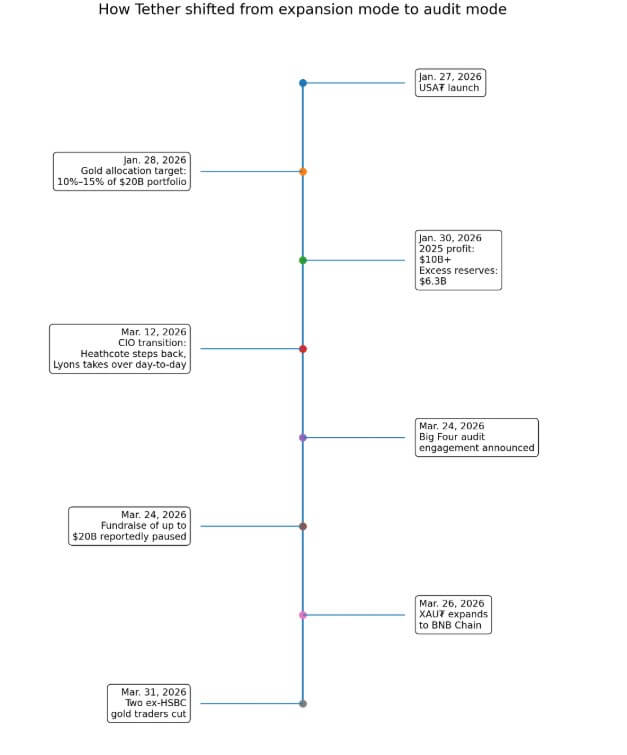
USAT launch on Jan. 27, gold allocation ambitions stated Jan. 28, profit disclosure Jan. 30, investment leadership transition Mar. 12, Big Four audit announced Mar. 24, fundraising pause reported the same day, XAUT expansion to BNB Chain on Mar. 26, and gold-desk layoffs on Mar. 31.
These movements trace a company reorganizing around a single internal priority: make the reserve perimeter legible, clearly segregate the non-reserve portfolio, and arrive at the audit process looking simpler than it did in early 2026.
Tether still held about 130 metric tons of physical gold at the end of 2025, and four days before cutting the desk, it expanded XAUT to BNB Chain and noted the tokenized gold market had grown from roughly $1.3 billion to more than $4 billion in 2025, with XAUT commanding about 60% of that market.
Tether said it was still building a “state-of-the-art gold team,” optimizing operations, and repositioning gold from an expansion symbol to a reserve asset and tokenized product.
This is the central shift in the narrative: Tether appears to be moving from expansion optics to audit optics. The question is no longer how broad its ambitions are, but whether it can make a sprawling reserve narrative look clean enough to withstand full scrutiny.
The disclosure race
Circle has spent years using disclosure as a competitive weapon.
| Metric | Tether / USDT | Circle / USDC |
|---|---|---|
| Circulation / market cap | $184B+ | $77B+ |
| Disclosure cadence | Attestations; now moving to full audit | Weekly reserve disclosures |
| External assurance | Big Four full audit announced | Monthly reserve assurance from Big Four |
| Reserve narrative | Large scale, broader reserve/perimeter questions | Simpler institutional disclosure pitch |
| Strategic issue in article | Credibility gap despite dominance | Disclosure used as competitive weapon |
USDC has over $77 billion in circulation as of late Mar. 31, and publishes weekly reserve disclosures and receives monthly reserve assurance from a Big Four firm.
Tether’s USDT sat above $184 billion, and coexisted with a persistent credibility gap that Circle’s institutional pitch exploits in enterprise sales cycles. By committing to a full financial statement audit rather than continued attestation, Tether aims to close that gap without surrendering its volume dominance.
The timing tracks a regulatory deadline. The OCC’s proposed GENIUS Act rules, circulated in February 2026, explicitly cover reserve assets, redemption standards, risk management, audits, and financial reporting, including examination of foreign issuers.

The new regulatory bar demands end-to-end parsability of a stablecoin issuer’s reserve system and governance. Tether’s Mar. 24 announcement, calibrated to both Circle’s disclosure pressure and the reality that USDT’s $184 billion scale makes it a regulatory target regardless of management preference, reads as a direct answer to that standard.
Reuters noted that Tether’s equity as a share of assets fell to 3.3% at year-end 2025, while cash-like reserves dropped to 76% of assets. Meanwhile, holdings like Bitcoin, gold, and secured loans rose to 24%.
Tether disclosed $6.3 billion in excess reserves against roughly $186.5 billion in liabilities, a cushion of about 3.4%. At that margin, a full audit carries solvency-optics weight for a company, backstopping the dominant quote currency across crypto trading pairs and serving over 550 million users.
The Federal Reserve published a note on Mar. 30 stating that payment stablecoins can affect liquid-asset markets, bank reserve balances, and the implementation of monetary policy.
IMF research found that a 1% increase in combined USDC and USDT market cap lowers the 1-month T-bill yield by 1.9 basis points at the trough, while a BIS/IMF paper found more than 70% of cumulative net stablecoin inflows came from non-USD currencies.
Tether’s push to harden its books is happening precisely as USDT draws the attention of central banks and crypto markets alike.
Potential outcomes
If the process completes without material complexity in the reserve or affiliated-entity structure, Tether reopens its fundraise with a disclosure profile closer to Circle’s, widens institutional access to USDT, and reframes the gold-desk cuts as the kind of operational decision a mature financial infrastructure provider makes.
Goldman Sachs projected gold at $5,400 per ounce by year-end 2026. If prices recover, XAUT captures the upside while the physical desk Tether cut becomes a sunk cost.
The company will have traded a few months of Empire Optics for something more durable: the right to be priced like audited infrastructure rather than a crypto-native operator running on goodwill and quarterly attestations.
| Scenario | Trigger | What changes for Tether | What it means for crypto markets |
|---|---|---|---|
| Bull case: clean audit | No material reserve or affiliated-entity complexity | Fundraise reopens; disclosure profile moves closer to Circle; gold-desk cuts look disciplined | USDT gains institutional credibility; reserve debate cools |
| Bear case: protracted audit | Control/classification/documentation issues delay completion | Fundraise stays shelved; reserve-composition scrutiny persists | Rivals gain narrative ground; every BTC/gold move revives credibility concerns |
The bear case is a protracted audit. Control or classification issues in the $20 billion proprietary portfolio, formally segregated from USDT reserves but routed through affiliated entities requiring clean documentation, delay completion, and the fundraise stays shelved.
Every price move in Bitcoin or gold reopens the debate over reserve composition in a news cycle that Tether can no longer contain with an attestation update.
The 3.4% equity cushion leaves little room for narrative drift, and each quarter without a completed audit widens the window for rivals to claim the credibility ground Tether vacated by inviting the inspection before the results arrived.
The company that built the world’s most consequential stablecoin is now betting that looking auditable is worth more than looking ambitious.
The next test is whether the audit closes on time, with reserve boundaries, controls, and affiliated-entity documentation clear enough to hold. Until then, every delay keeps the credibility question open for the issuer behind crypto’s most important trading dollar.
The post Tether hired top HSBC gold traders, then cut them weeks before auditors arrive appeared first on CryptoSlate.