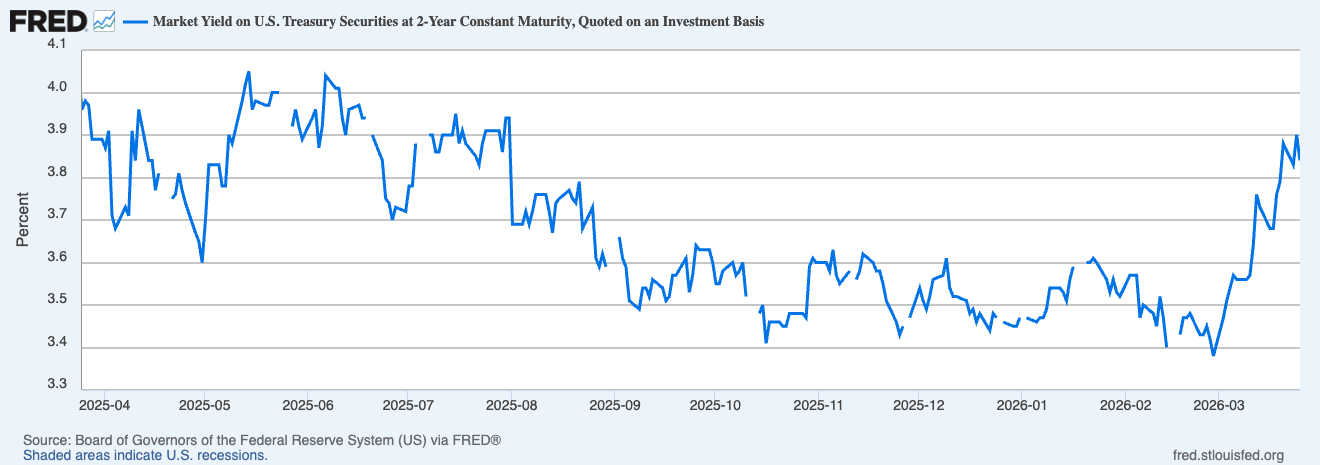
Even the safest corners of the market can start to look uneasy when oil jumps, war drags on, and investors begin to wonder whether inflation is heading back in the wrong direction.
That was the message we got from Tuesday’s sale of 2-year US Treasuries. These are short-term government bonds, and they’re widely watched because they reflect what investors think could happen over the next couple of years, especially with Federal Reserve interest rates.
When demand for these short-duration Treasurys is strong, it tells us professional and institutional investors believe inflation will ease and policy will eventually soften.
So when the demand weakens, the signal shifts as well. Investors are asking for better compensation, and they’re preparing for a bumpier stretch ahead.
Tuesday’s auction landed in that second category. The Treasury sold $69 billion of 2-year notes at a 3.936% high yield, and demand came in weaker than the previous month. The bid-to-cover ratio fell to 2.44 from 2.63 in February, while primary dealers ended up taking a much larger share of the sale.
These numbers tell us investors showed less appetite than usual for lending money to the US government for just two years at a 3.9% interest rate.
The weak sale arrived at a moment when the Middle East conflict had pushed oil higher, and hopes for quick Federal Reserve rate cuts were starting to fade. US business activity slowed to an 11-month low in March even as costs and selling prices accelerated, a combination that left investors staring at a pretty uncomfortable economic picture.
The 2-year Treasury is one of the market’s best readings on where investors think interest rates are headed in the near future. A weak auction signals that traders aren’t convinced the Fed will be able to ease policy soon. It can also signal that inflation fear is starting to outrun the usual instinct to rush into government debt during a geopolitical shock.
Why this simple auction became a warning sign
For the better part of the last year, investors were hoping for a light at the end of the tunnel. Inflation seemed to be coming down, and growth was cooling in an orderly way, which would enable the Fed to eventually have room to cut rates. Short-term Treasury bonds would fit neatly into this recovering market, as they offered a profitable way to position for easier policy ahead.
But all of this fell apart with the recent oil shock. As the conflict in Iran threatens to turn into a full-blown war in the Middle East, oil prices skyrocketed, feeding into gasoline and broader business costs. This essentially annulled all of the softening we’ve seen in business activity, leaving markets wrestling with the prospect that the economy could slow down while inflation goes up. That combination would prevent the Fed from offering any kind of easy relief in the next year or so.
Once we start considering this as a real possibility, the meaning of a “safe” asset changes.
While the relative safety of an asset still counts in these circumstances, inflation counts more.
Investors begin asking whether holding a 2-year Treasury at a given yield really offers enough protection when energy prices are climbing, and the path to lower rates looks less certain. That’s why this week’s weak demand drew so much attention: it showed the market wanted more returns before stepping in.
Fed rhetoric has added to that unease. Fed Governor Michael Barr said policymakers may need to hold rates steady for some time because inflation remains above target and the Middle East conflict has added upside risk through energy.
Comments like that help explain why the 2-year Treasurys are so important: they’re the part of the Treasury market most tightly linked to the next chapter of Fed policy. When it starts to wobble, investors are usually reacting to what they think the central bank may or may not be able to do next.
What the signal says about the economy from here
This month’s auction was a warning flare for the next few months.
Investors are starting to test whether any of the old assumptions still hold: Can inflation keep easing if oil stays elevated? Can the Fed cut rates if energy costs start raising prices even more?
The answers to these questions will affect everyone, not just Treasury buyers.
Higher short-term yields can keep financial conditions tight, pressure valuations in other markets, and raise the hurdle for risk-taking across stocks and speculative assets. They can also change borrowing conditions, because expectations for the Fed’s future policy spill into all kinds of pricing decisions.
That’s why a weak auction at the front end of the curve can end up telling a larger story about confidence, fear, and how investors see the next phase of the economy taking shape.
There’s still room for this signal to cool. Ceasefire hopes helped oil prices pull back a bit, and that kind of move can ease some of the pressure on inflation expectations.
Nonetheless, the market is still arguing with itself, and the argument is alive in every fresh oil headline, every Fed remark, and every new read on prices and growth.
For now, the message from the auction is clear: investors are looking at the next two years and seeing a rougher road than they saw a month ago. They’re seeing war, oil, inflation, slower activity, and a Federal Reserve that has less room to ride to the rescue than markets had hoped. And we saw a glimpse of a market starting to price in a more difficult world.
The post Is anywhere safe as Bitcoin weakens? Why even the 2-year Treasury is starting to crack appeared first on CryptoSlate.