
Bond markets, not oil alone, may decide Bitcoin’s fate this week
The market is still treating oil as the center of the current macro shock.
Market conditions after this weekend point somewhere else. Oil is the spark, bond markets are the channel, and Bitcoin is trading inside that channel as the week begins.
That is the setup now facing investors.
The geopolitical shock still carries weight. Crude can reshape inflation expectations, complicate central-bank decisions, and hit risk sentiment in a single move. The bigger issue, however, is what that energy shock is doing to sovereign debt markets at a moment when investors were already questioning how much inflation relief they could realistically expect in 2026.
That shift in focus takes the conversation from oil to yields, from yields to global bond pricing, and then directly to Bitcoin.
Bitcoin is operating in a market where the long end of the curve has become impossible to ignore.
Right now, the long end is under pressure.
The core thesis is straightforward: markets have already priced in war risk through energy, while the next repricing phase is centered on whether that energy shock becomes persistent enough to keep long-term yields elevated, delay policy relief, and tighten financial conditions across the board.
Every risk asset feels that process, and Bitcoin sits especially close to it because it still straddles two roles. In the short run, it behaves like a liquidity-sensitive macro asset. Over a longer horizon, it still carries the appeal of a hard-asset hedge.
That tension sits at the center of the current setup.
The Kobeissi Letter moved closer to the right framework this weekend, arguing that oil prices are no longer the only threat to markets and that bond markets will play a major role in determining how long Washington can maintain pressure in the Iran conflict. The key takeaway from that argument lies in the market mechanics.
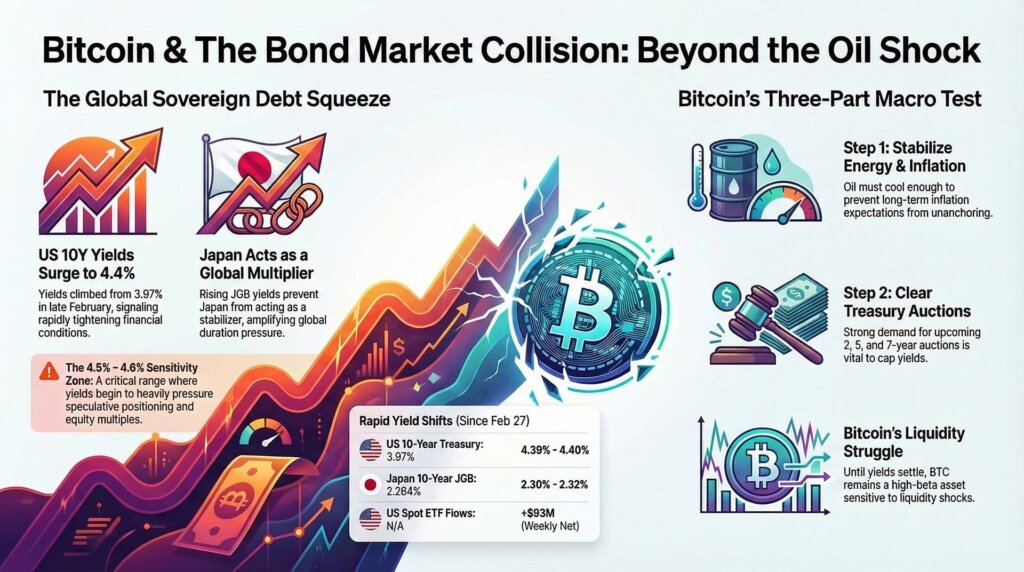
The U.S. 10-year yield climbed sharply after the war began on Feb. 28. Official Treasury data shows it moved from 3.97% on Feb. 27 to 4.39% by March 20, with live trading pushing it back toward the 4.4% area on Monday. That move is large enough to confirm that yields have risen quickly and that the bond market is applying real pressure on broader financial conditions.
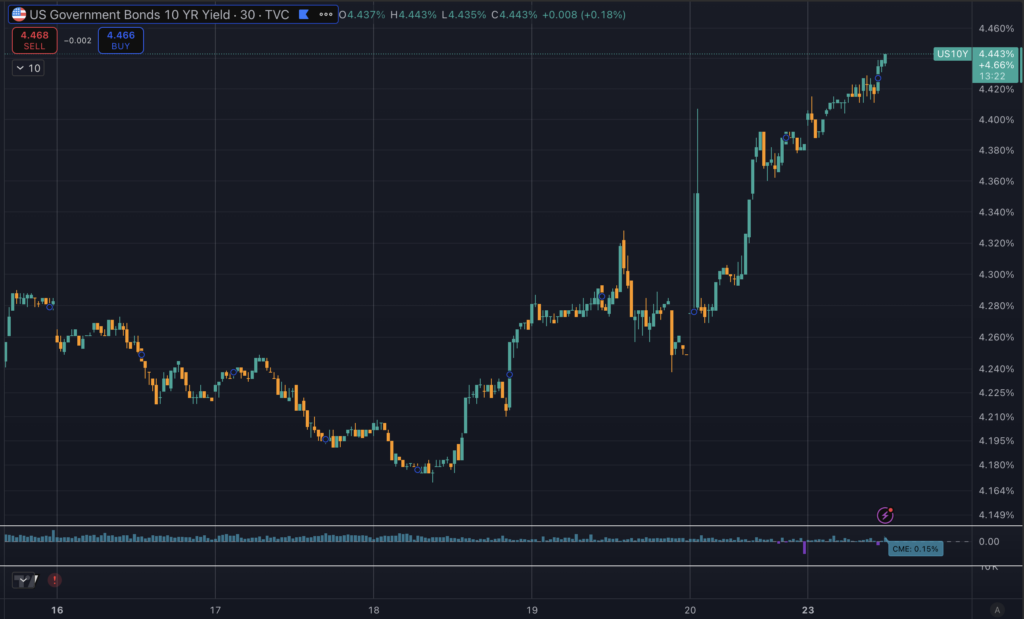
Yield zone becomes the binding constraint for risk assets
The 4.50% to 4.60% zone on the 10-year deserves a more careful description. It reads best as a politically and financially sensitive range, rather than a fixed tripwire that forces an immediate response.
Markets rarely move with that kind of precision. Even so, recent experience suggests the White House pays close attention when the long end rises far enough to threaten broader risk conditions.
For Bitcoin, the implication is clear. The central question is no longer limited to whether oil moves higher. The more important issue is whether oil remains firm enough to keep inflation fears alive and lift yields into a range that pressures duration, equity multiples, and speculative positioning at the same time.
That is why the yield response deserves the bulk of investor attention.
The broader macro backdrop offers little relief.
The Federal Reserve held rates at 3.50% to 3.75% last week and signaled that the Middle East situation adds another layer of uncertainty to the policy outlook. The surrounding data reinforced that caution.
February CPI came in at 2.4% year over year, with core at 2.5%. February PPI ran hotter on a monthly basis. Payroll growth has cooled, and consumer sentiment has weakened. The University of Michigan’s preliminary March reading also showed inflation expectations rising, with gasoline prices standing out as a visible pressure point for households.
That combination leaves markets facing a difficult mix, softer growth signals arriving alongside renewed inflation anxiety.
Bitcoin tends to struggle when that mix starts feeding directly into the term premium.

Japan now deserves a much bigger place in the conversation
One of the most underappreciated risks in the current environment is that this has expanded beyond a U.S. Treasury move. Japanese government bond yields have also moved higher since Friday, with the 10-year JGB rising from 2.264% on March 20 into roughly the 2.30% to 2.32% range on Monday.
Longer-dated yields moved higher as well, with the 30-year and 40-year both pressing upward.
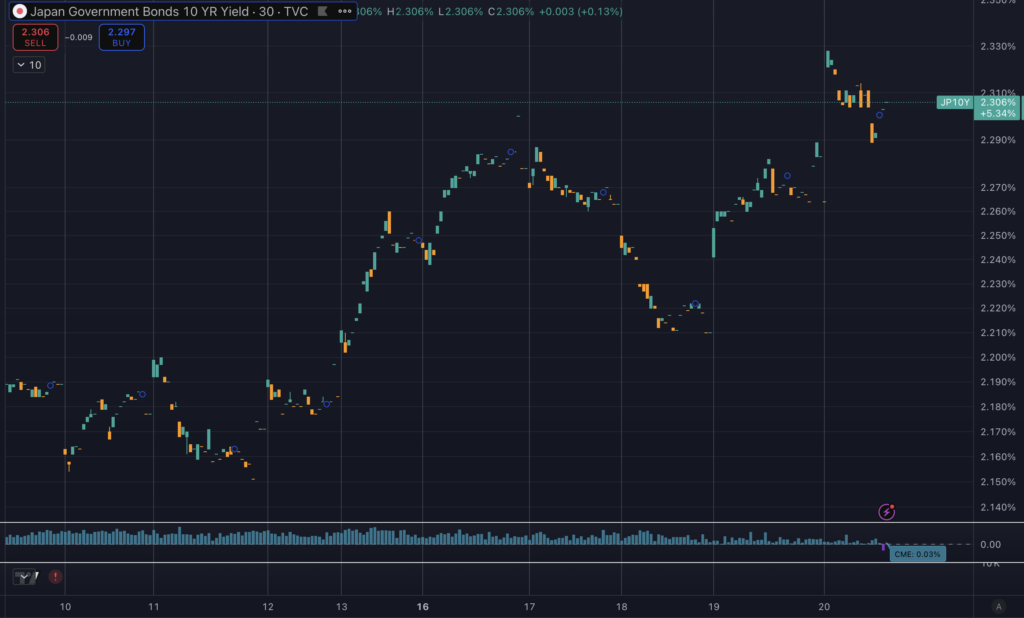
At the same time, 10-year JGB futures remained pinned near recent lows after Friday’s selloff instead of staging a convincing rebound.
That development adds another layer to the macro pressure.
Japan matters in global duration markets because rising JGB yields can influence capital flows, relative-rate pricing, hedging decisions, and the broader cost of money worldwide.
When JGBs reprice higher while Treasuries and gilts remain under pressure, the market begins to treat the energy shock as a global bond-market event rather than a localized oil panic.
That shift creates another challenge for Bitcoin.
The Bank of Japan reinforced that theme last week when it acknowledged that crude prices had risen significantly and warned that higher oil would place upward pressure on consumer prices.
The BOJ did not signal panic, but it also did nothing to cool the sense that inflation risk is broadening. Markets had already been pricing meaningful odds of another BOJ hike, and reports that Japan is considering trimming buybacks of inflation-linked bonds have only added to the sense that local inflation expectations are stirring again.
That leaves Japan acting less like a stabilizer and more like an amplifier.
Bitcoin traders often want the asset treated as digital gold during geopolitical stress. Price action has so far pointed to a more complicated reality. When the oil shock hit, traders sold Bitcoin instead of moving into it as a traditional haven. That response does not invalidate the hard-asset case over a longer horizon. It does show that timing plays a crucial role.
Bitcoin can still attract a more defensive bid later, especially if the policy response to weaker growth becomes more aggressive or if investors begin focusing more intensely on fiat credibility and sovereign debt sustainability. In the first stage of a liquidity shock, rising yields still create a hostile backdrop.
The week ahead carries unusual weight
This week does not include the usual PCE inflation anchor, because February U.S. PCE has been pushed back to April 9.
As a result, markets will lean more heavily on secondary signals. That raises the importance of Treasury auctions, PMI data, jobless claims, and survey-based inflation expectations.
Those releases form the scoreboard for the week.
Tuesday’s flash PMIs will offer an early sense of whether business activity is absorbing the shock or beginning to wobble. The 2-year Treasury auction lands the same day, followed by the 5-year on Wednesday and the 7-year on Thursday. Friday brings the final University of Michigan sentiment reading and an updated look at inflation expectations.
If the auctions come in weak and inflation-expectations data stay firm, the 10-year could move toward the mid-4% range quickly. That environment would keep Bitcoin under pressure even if oil pauses. Under that scenario, BTC would likely remain inside the market’s liquidity bucket as investors reprice higher-for-longer conditions.
A different path is also possible. If auctions clear well, PMIs soften enough to cap the long end, and inflation expectations cool, yields could stabilize even without a dramatic collapse in crude. That would offer a more constructive opening for Bitcoin.
Markets could begin shifting away from immediate concern over sticky inflation and toward a broader view in which the growth hit from the shock eventually outweighs the energy spike itself.
That is the point where Bitcoin’s hard-asset appeal can start to re-enter the conversation more forcefully.
Bitcoin market structure still looks intact
Spot prices have pulled back from recent highs, yet institutional demand has continued to show through in pockets of the market. U.S. spot ETF flows for the week ending March 20 were still net positive overall (+$93 million), even though the final sessions weakened.
Futures basis also remained positive. That combination suggests a market that is still engaged and still highly sensitive to macro conditions, rather than one facing broad internal collapse.
Which brings the focus back to bonds.
Bitcoin’s next move may depend less on the next jump in crude and more on whether the bond market decides the inflation shock is temporary or persistent. Oil created the initial shock. Treasuries are shaping how tight financial conditions become, and Japan is increasingly reinforcing that repricing instead of easing it.
Bitcoin now faces a three-part macro test this week.
- Can oil stabilize quickly enough to keep inflation fears from building further.
- Can Treasury auctions prevent another sharp move higher in the long end.
- Can Japan avoid turning a U.S. bond selloff into a broader global duration squeeze.
If those pressures keep building, Bitcoin is likely to stay under strain and trade like a high-beta macro asset. If those pressures begin to ease, even partially, BTC has room to recover as markets start separating immediate war-driven stress from the wider monetary path ahead.
The current setup therefore runs deeper than crude alone. Oil started the fire, bonds are determining how far it spreads, and Japan is adding evidence that the repricing in sovereign debt is global.
Until the rate market settles, Bitcoin remains caught in the middle.
[Update 11:23 GMT: Rates nearing 4.5% have coincided with President Trump issuing a statement declaring “THE UNITED STATES OF AMERICA, AND THE COUNTRY OF IRAN, HAVE HAD, OVER THE LAST TWO DAYS, VERY GOOD AND PRODUCTIVE CONVERSATIONS REGARDING A COMPLETE AND TOTAL RESOLUTION OF OUR HOSTILITIES IN THE MIDDLE EAST.” Bitcoin jumped 4.5% immediately.]
The post Bitcoin focus shifts from oil to bonds as US and Japan 10-year yields spike into a critical week appeared first on CryptoSlate.